Dental insurance has its own vocabulary, and most of it was written by payers, not for the people who have to explain it to patients every day. Here's a working glossary of the terms that come up constantly at the front desk.
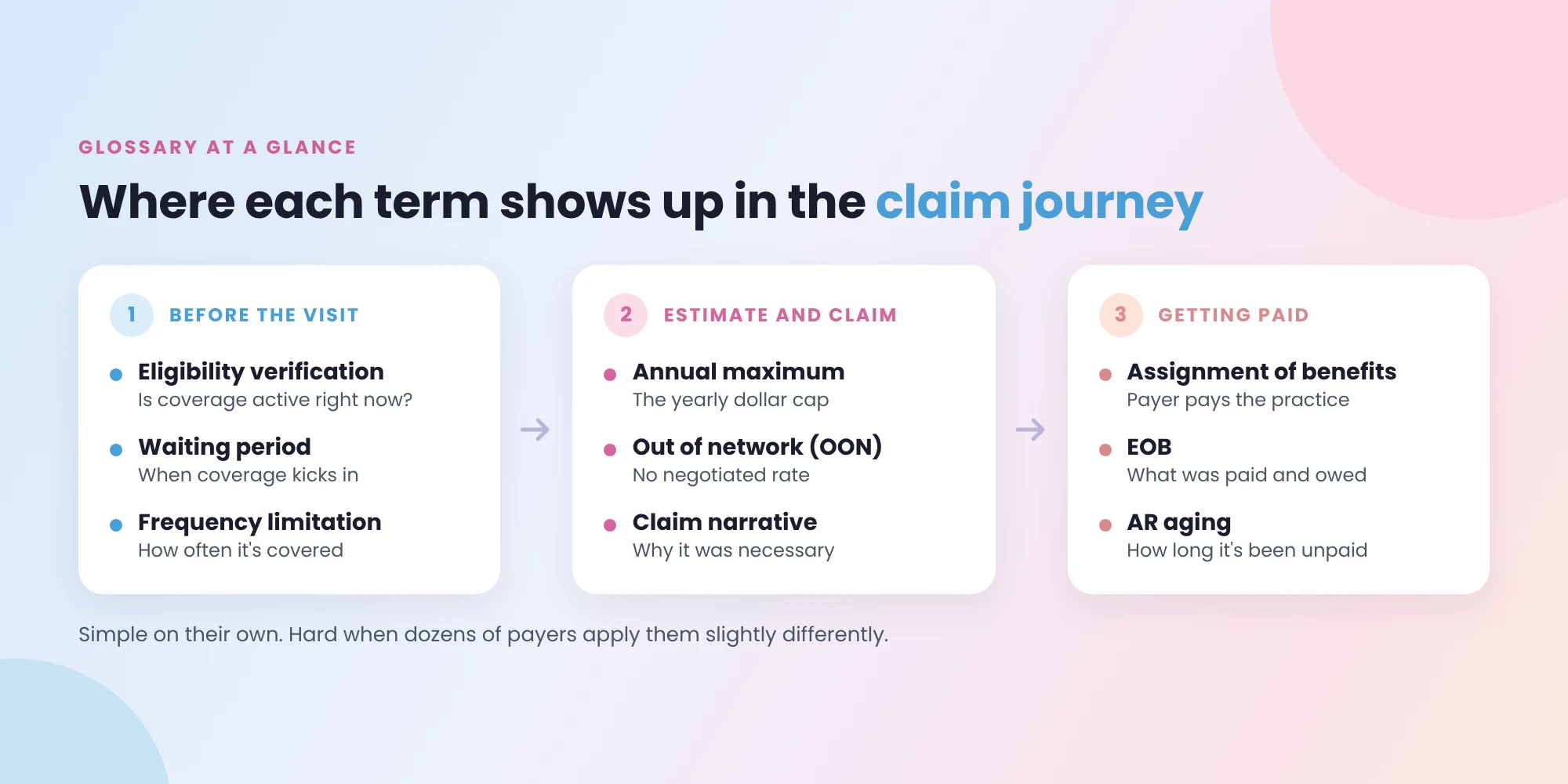
Eligibility verification. Confirming a patient's active coverage, benefit levels, and plan details before their appointment, rather than assuming last year's information still applies.
Frequency limitation. A payer's rule on how often a specific procedure is covered, most commonly seen with cleanings and exams limited to twice a year.
Waiting period. A length of time a patient must be enrolled in a plan before certain procedures are covered at all, common with major services on newer plans.
Annual maximum. The total dollar amount a plan will pay toward a patient's dental care in a benefit year, after which the patient is responsible for the full remainder.
Claim narrative. The written explanation attached to a claim describing why a procedure was medically necessary. Payers vary widely in what they expect to see here, and a mismatched narrative is one of the most common, and most preventable, reasons a clean claim still gets denied.
EOB, or explanation of benefits. The payer's breakdown of what was billed, what was covered, and what the patient owes, sent after a claim is processed. Reconciling these against what was actually posted to the patient's account is its own time consuming task, separate from the claim submission itself.
AR aging, or accounts receivable aging. A report showing how long claims and patient balances have been outstanding, typically grouped into buckets like 30, 60, and 90 plus days. The longer a claim sits unresolved, the less likely it is to ever get paid in full.
Assignment of benefits. An agreement where the patient directs their insurance company to pay the practice directly, rather than reimbursing the patient who then owes the practice the full fee.
Out of network, or OON. A provider who doesn't have a negotiated rate contract with a given payer. Patients often have different, usually less favorable, benefit levels for OON care, which makes clear estimate language especially important.
None of these terms are complicated on their own. What makes dental insurance hard is managing dozens of payers who each apply them slightly differently, for every patient, every single day.