The hidden cost behind every insured patient
Most dental offices know insurance work eats time. Few know exactly how much. Add up every step, from verifying benefits to posting the payment, and a typical PPO office spends close to 50 minutes of staff time on each insured patient.
Most of those minutes disappear into phone holds, portal tabs, fax machines and retyping. Every handoff is also a chance for error. One misread number on a call with a payer rep can get a claim rejected and send the whole process back to the start.
Below, we walk through a model office step by step: where the time goes today, and what changes when the routine parts are automated. The numbers come from a presentation Dr. Tuan Pham, DDS, a former practice owner, gave to a dental study group. They are illustrative estimates, so plug in your own.
Meet the model office
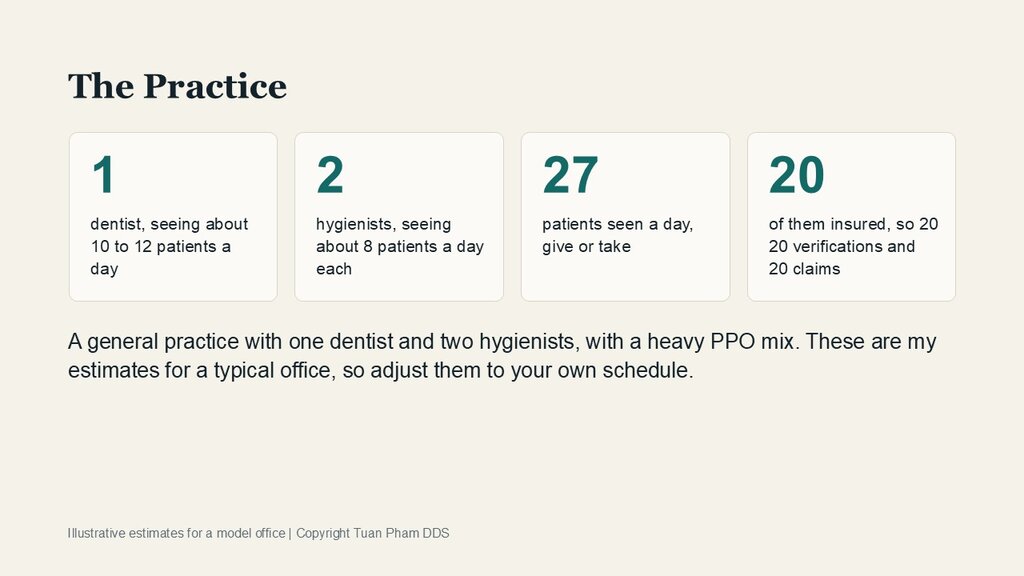
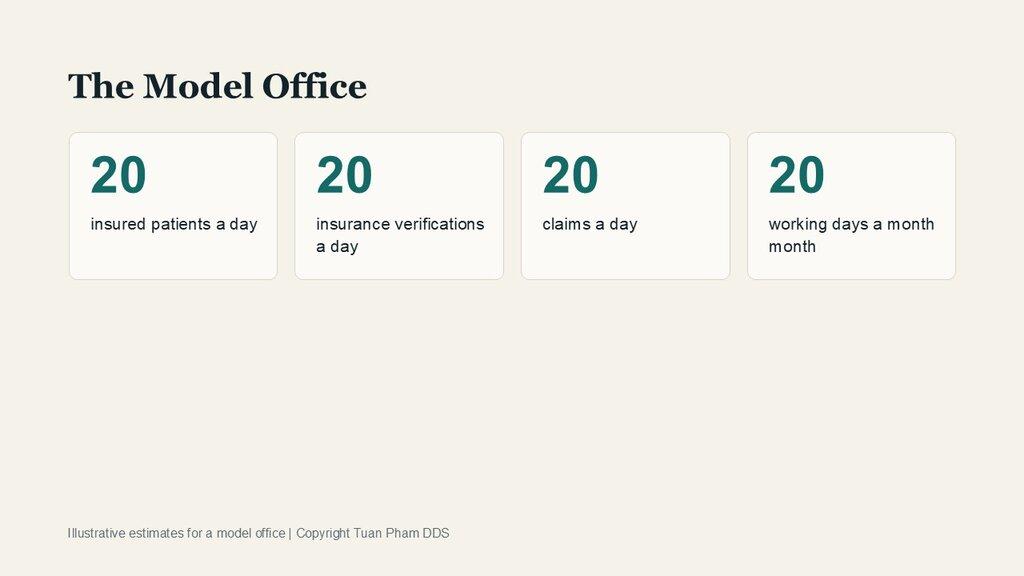
Picture a general practice with one dentist, two hygienists and a heavy PPO mix. It sees about 27 patients a day, and 20 of them are insured. That means 20 verifications and 20 claims, every working day.
Step 1: Verifying insurance takes 21 minutes per patient
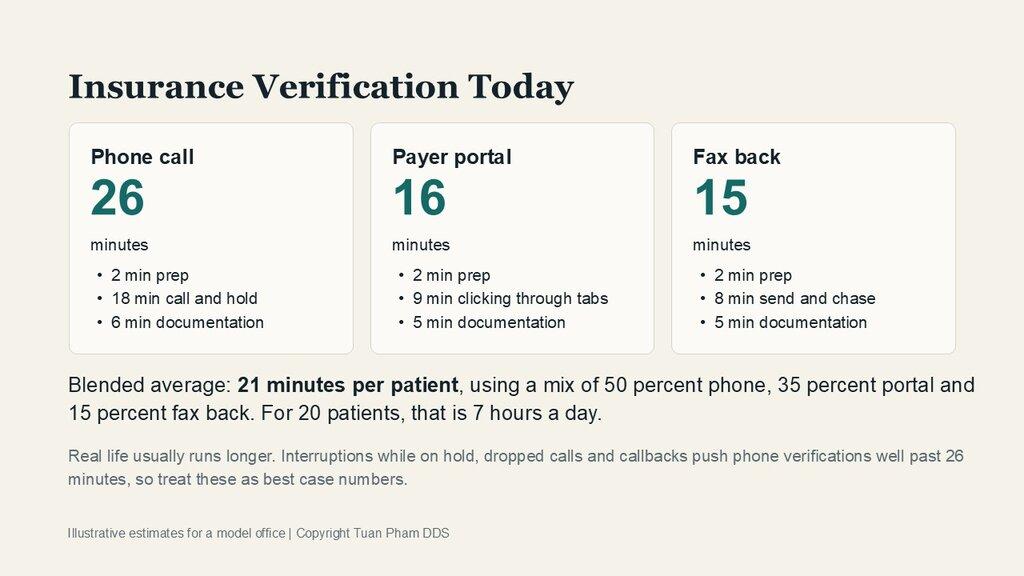
Verification is the single biggest time sink. A phone call averages 26 minutes once you count prep, the hold and documentation. A payer portal takes about 16, and a fax back about 15. With a typical mix of channels, that blends to 21 minutes per patient, or 7 hours a day for 20 patients.
And those are best case numbers. Patient interruptions, dropped calls and callbacks can easily double the time on a phone verification. Multitasking during holds helps a little, but it also raises the risk of mistakes on every task in progress.
Step 2: Building the claim takes 15 minutes
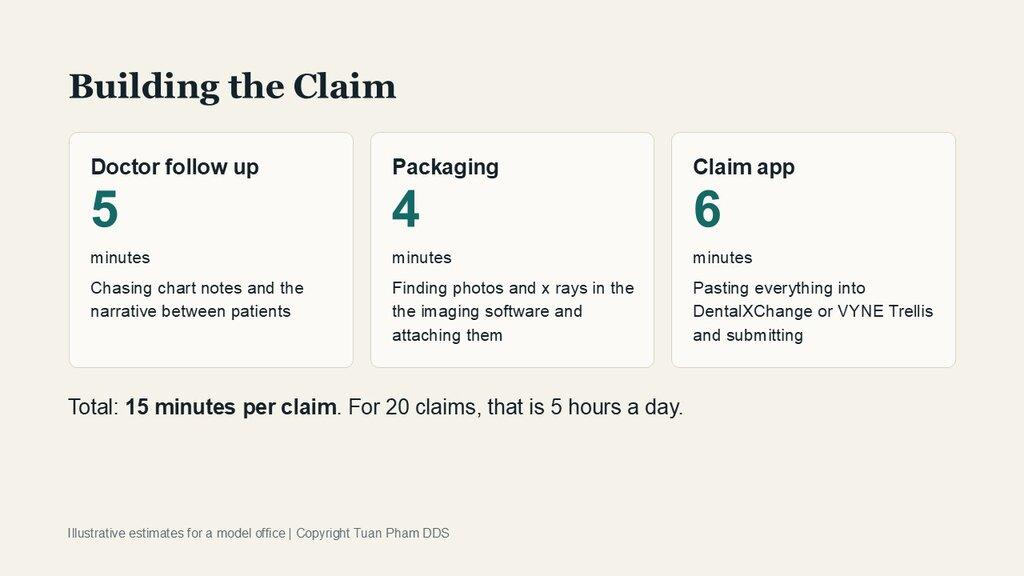
After the visit, someone has to chase the doctor for chart notes and a narrative, find the right photos and x rays, then paste everything into the claim app. That adds up to about 15 minutes per claim, or 5 hours a day.
Anyone who has worked the front desk knows the hardest part: tracking down chart notes and narratives between patients. Some offices trim this by having the front desk draft narratives.
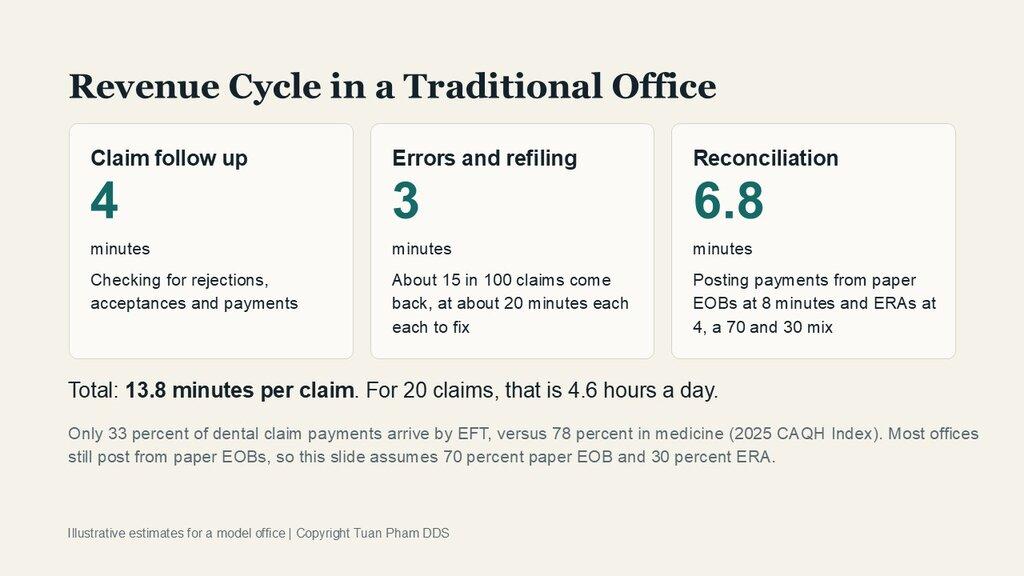
Step 3: Follow up and reconciliation take another 13.8 minutes
The claim is out the door, but the work is not done. Staff check for rejections and payments, fix and refile the claims that come back, and post payments. Posting is slow because most dental payments still arrive as paper EOBs. That is another 13.8 minutes per claim, or 4.6 hours a day.
Start to finish: 49.8 minutes per insured patient
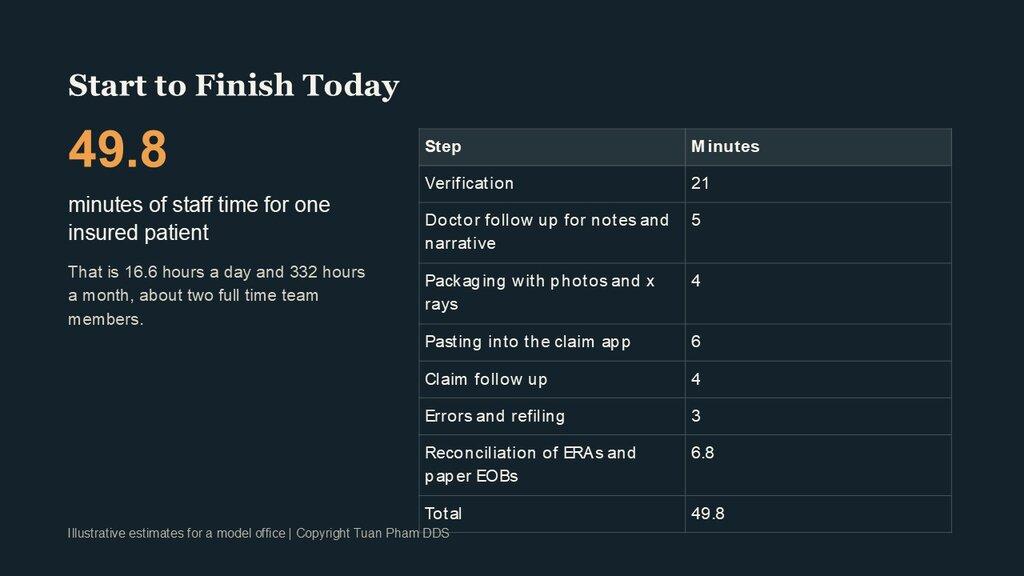
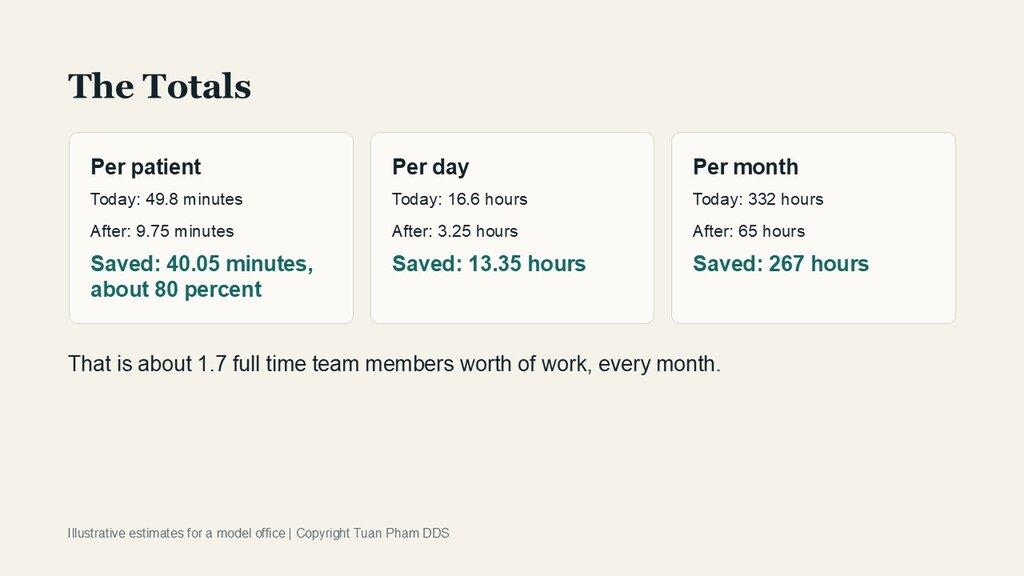
Put it all together and one insured patient costs 49.8 minutes of staff time. Across 20 patients, that is 16.6 hours a day and 332 hours a month, roughly the work of two full time team members. For one practice owner, the front desk team behind this work cost close to $200,000 a year after benefits.
Why does the same plan look different on the phone, portal and fax?
It is one of the most common questions from front desk teams. The short answer: nothing forces payers to make their data consistent across channels, so they don't. Messier data means slower verification, and slower verification tends to mean slower payments.
Phone and portal usually give the most complete picture, but they cost the most time and add the most chances for error, both while recording data and while typing it back into your practice management system. Fax backs carry less detail.
The fastest source is the clearinghouse, which sends eligibility data in a format called X12. The standard dates back to 1979 and was built for medical data, with dental added later. So details dentists care about, like frequencies and downgrades, are uneven: some payers send them, some send part, some send none.
The good news is that clearinghouse data covers roughly 85 percent of what most offices need. That changes the job. Instead of gathering everything by phone, staff only check the portal for the few missing data points.
What automation changes
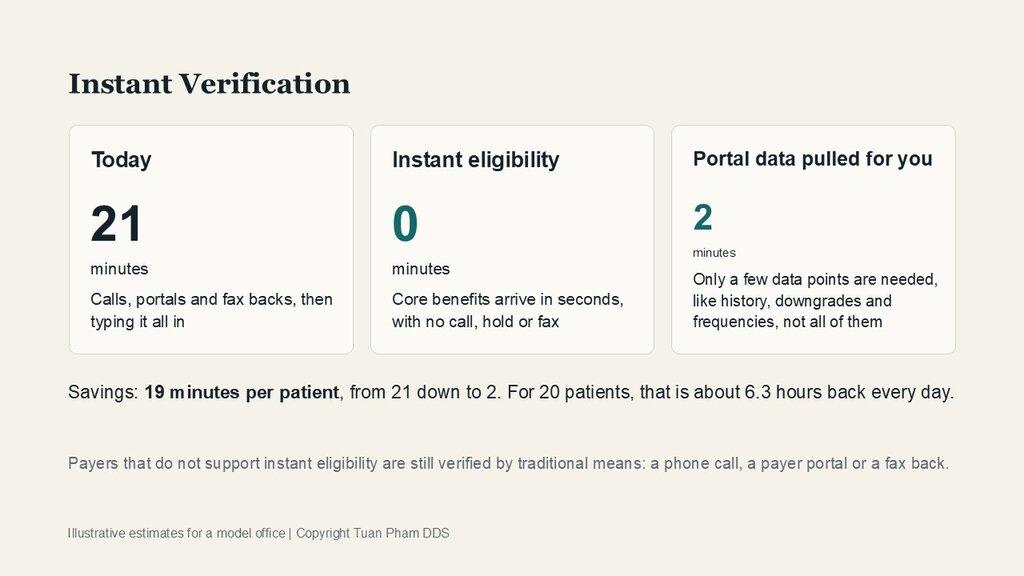
Verification drops from 21 minutes to 2
With instant eligibility, core benefits arrive in seconds with no call, hold or fax. Staff only spend a couple of minutes pulling the handful of details clearinghouses often miss, like history, downgrades and frequencies. That saves 19 minutes per patient, or about 6.3 hours a day. Payers that don't support instant eligibility still get verified the traditional way.
Why not automate the portals too? Some services do offload all of it, but they rely on people, often offshore, which brings the errors back. Fully automated portal scraping breaks payer terms of service. Payers watch for bot patterns like mouse movement and speed and lock out accounts that trip them, so it cannot scale safely.
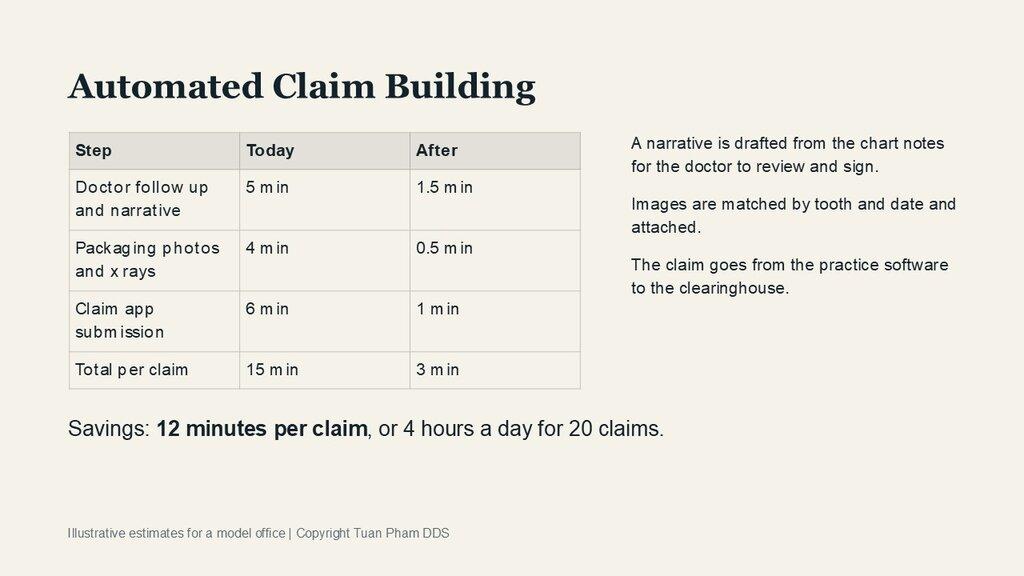
Claim building drops from 15 minutes to 3
A narrative is drafted from the chart notes for the doctor to review and sign. Images are matched by tooth and date and attached. The claim goes from the practice software straight to the clearinghouse. That saves 12 minutes per claim, or 4 hours a day.
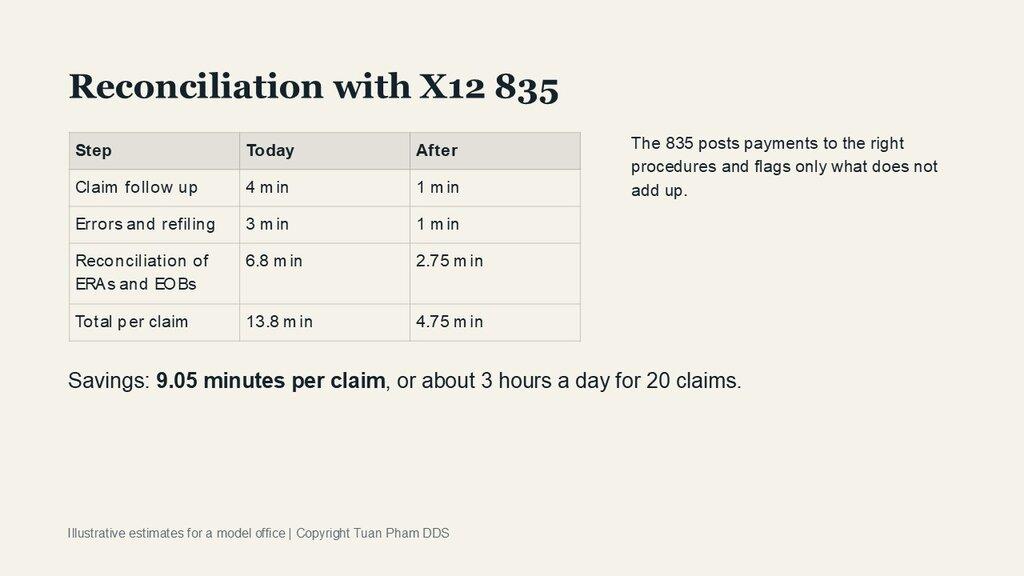
Reconciliation drops from 13.8 minutes to 4.75
The key here is the X12 835, the electronic version of the paper EOB. It lists each claim, what was paid, what was adjusted and why, and what the patient owes, in a form software can read and post on its own. It explains the EFT that lands in your bank account.
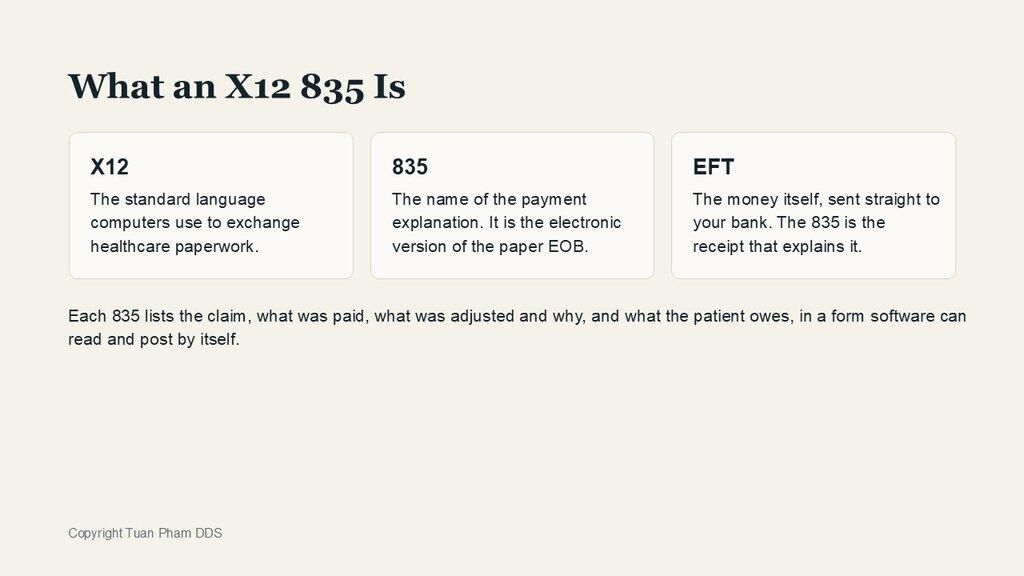
When software reads the 835, payments post to the right procedures and only the exceptions get flagged for a person. That saves 9.05 minutes per claim, or about 3 hours a day.
Why this matters more in 2027: the move to EFT
Payers are pushing offices toward electronic payments. Starting January 1, 2027, Delta Dental of California and its affiliated companies will make EFT their standard payment method, and in network offices that keep receiving paper checks will pay a $15 weekly processing fee (NYSDA). Other payers may follow, or steer offices to virtual credit cards that carry 2 to 3 percent processing fees.
EFT has real upsides: faster payment and less fraud, since there is no paper check to intercept. The reason many offices dread it is reconciliation. Without a paper EOB, someone has to log in to each portal and cross reference payments by hand. Software that reads the 835 and reconciles automatically takes that worry off the table.
The totals: about 80 percent less time per patient
Step by step, automation shrinks every part of the workflow.
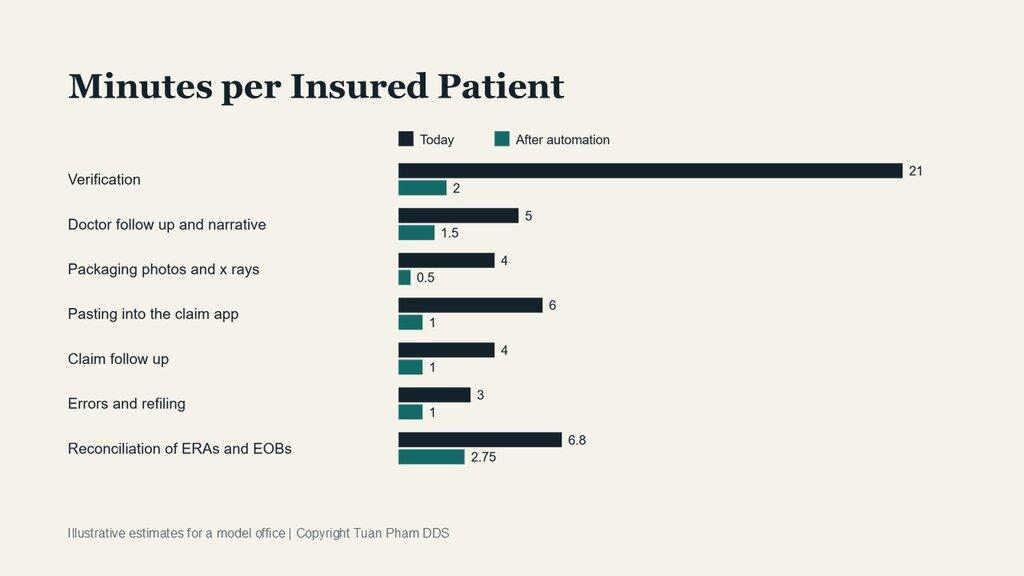
Per insured patient, staff time falls from 49.8 minutes to 9.75. For the model office, that is 13.35 hours back every day and 267 hours a month, about 1.7 full time team members' worth of work.
What your team does with the time back?
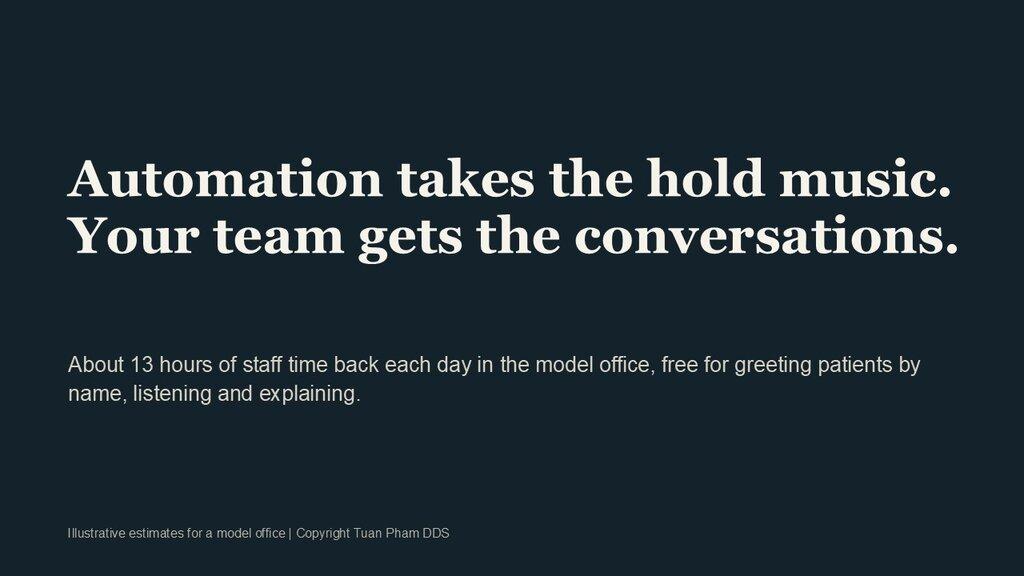
The real payoff isn't just fewer hours. It's what your front desk can do with them. Think about checkout in a busy office:
"Mr. Smith, the doctor recommended three fillings. Would you like to schedule? No? OK, I'll call you next week."
In that moment, the front desk had no time to reinforce the treatment plan. It also just created more work: a follow up call, more reports and more tasks, all because the production never made it onto the books.
Now give that same person one or two extra minutes. They can answer the objection before the patient voices it ("My tooth doesn't hurt, do I really need this?") in 30 to 45 seconds. They can show the insurance coverage and walk through what happens if the patient waits: a filling today, a crown at $1,400 later, or a root canal and crown at $2,400 if it starts to hurt. Writing those numbers next to the estimate makes today's cost feel much smaller by comparison. Then they collect a deposit to lock in the appointment.
Production goes up, and the downstream workload goes down.
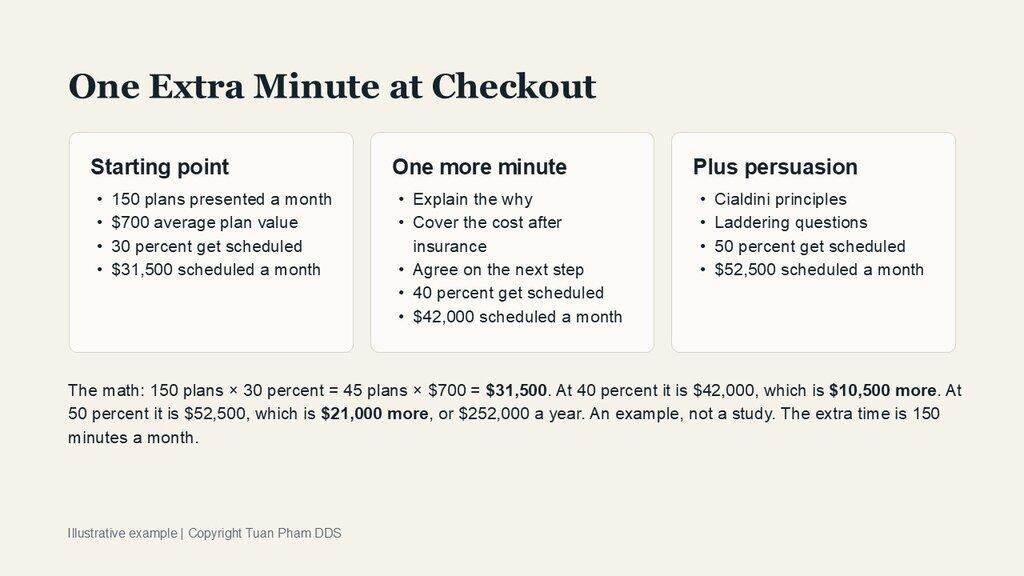
In this example, 150 treatment plans a month at a $700 average go from a 30 percent to a 40 percent scheduling rate. That adds $10,500 a month. Add proven persuasion techniques and reach 50 percent, and it's $21,000 more a month, or $252,000 a year. It's an example, not a study, but the extra time it takes is only 150 minutes a month.
Spend less time on hold and more time with patients
Automation is moving every industry forward, and dental billing is overdue. Taking routine work off your team's plate saves time and money, lowers stress, and frees people up for work that actually grows the practice.
Dental Maverick automates insurance verification, claims and reconciliation for dental offices. Join the waitlist to see how much time your office could get back.