A missing or weak narrative is one of the most common reasons a correctly coded claim gets denied or delayed. The good news: payers are mostly asking the same question every time. Why was this procedure necessary, for this tooth, right now?
A good narrative answers that clearly, in the clinician's own findings, backed up by the attachments.
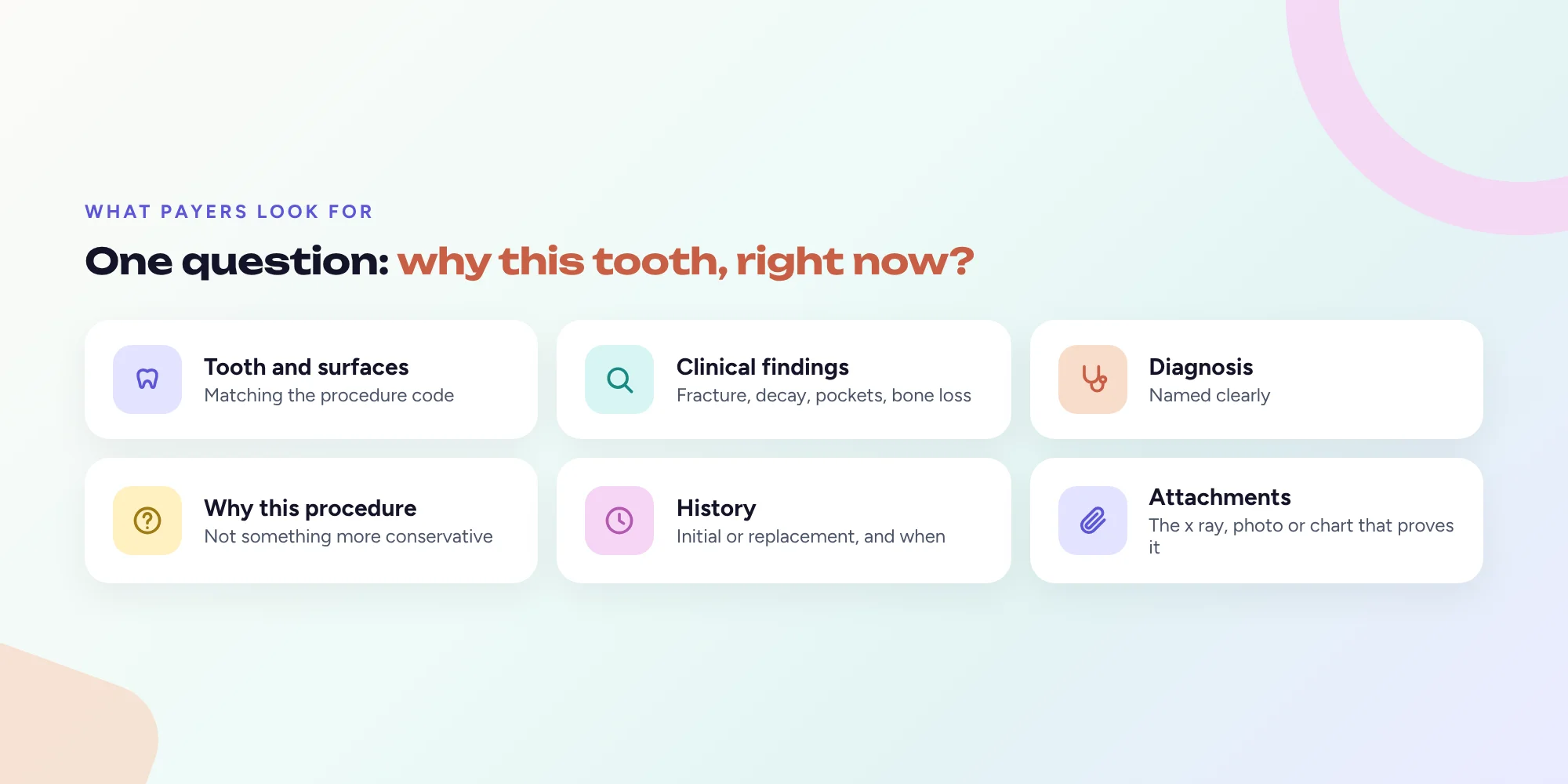
What payers are looking for
Across payer guidelines, the same elements come up again and again:
- Tooth number and surfaces that match the procedure code
- Objective clinical findings: fracture, decay, pocket depths, bone loss, mobility
- Diagnosis
- Why this procedure instead of something more conservative
- History: for a crown, is it an initial placement or a replacement, and if a replacement, when was the original placed?
- Reference to attachments: the x ray, photo or perio chart that shows what you're describing
A simple structure that works
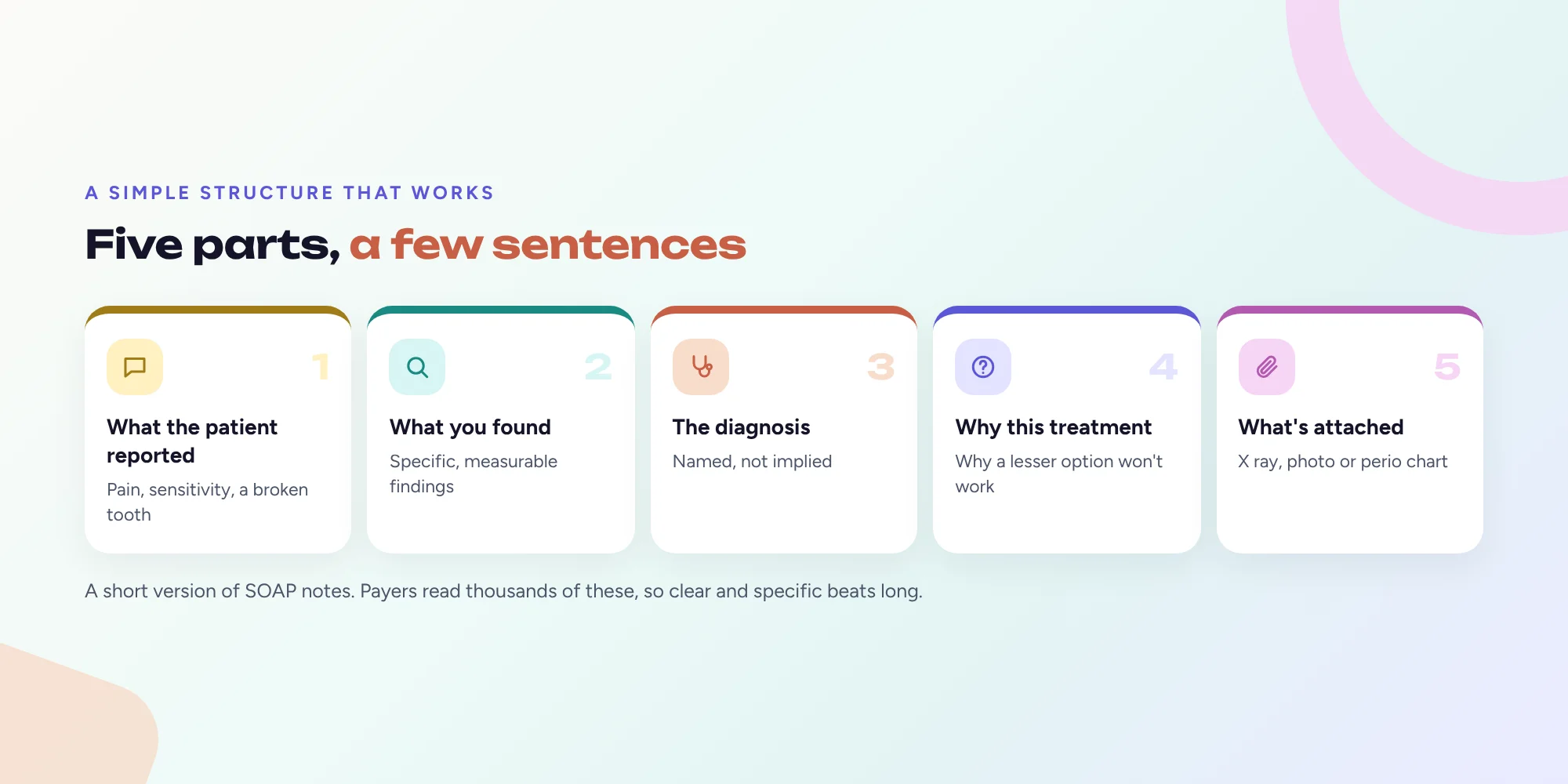
Many offices use a short version of SOAP notes:
- What the patient reported (if relevant): pain, sensitivity, a broken tooth.
- What you found: specific, measurable findings.
- The diagnosis.
- Why this treatment: what would happen with a lesser option, or why it isn't possible.
- What's attached.
Keep it to a few sentences. Payers read thousands of these. Clear and specific beats long.
Avoid these common mistakes
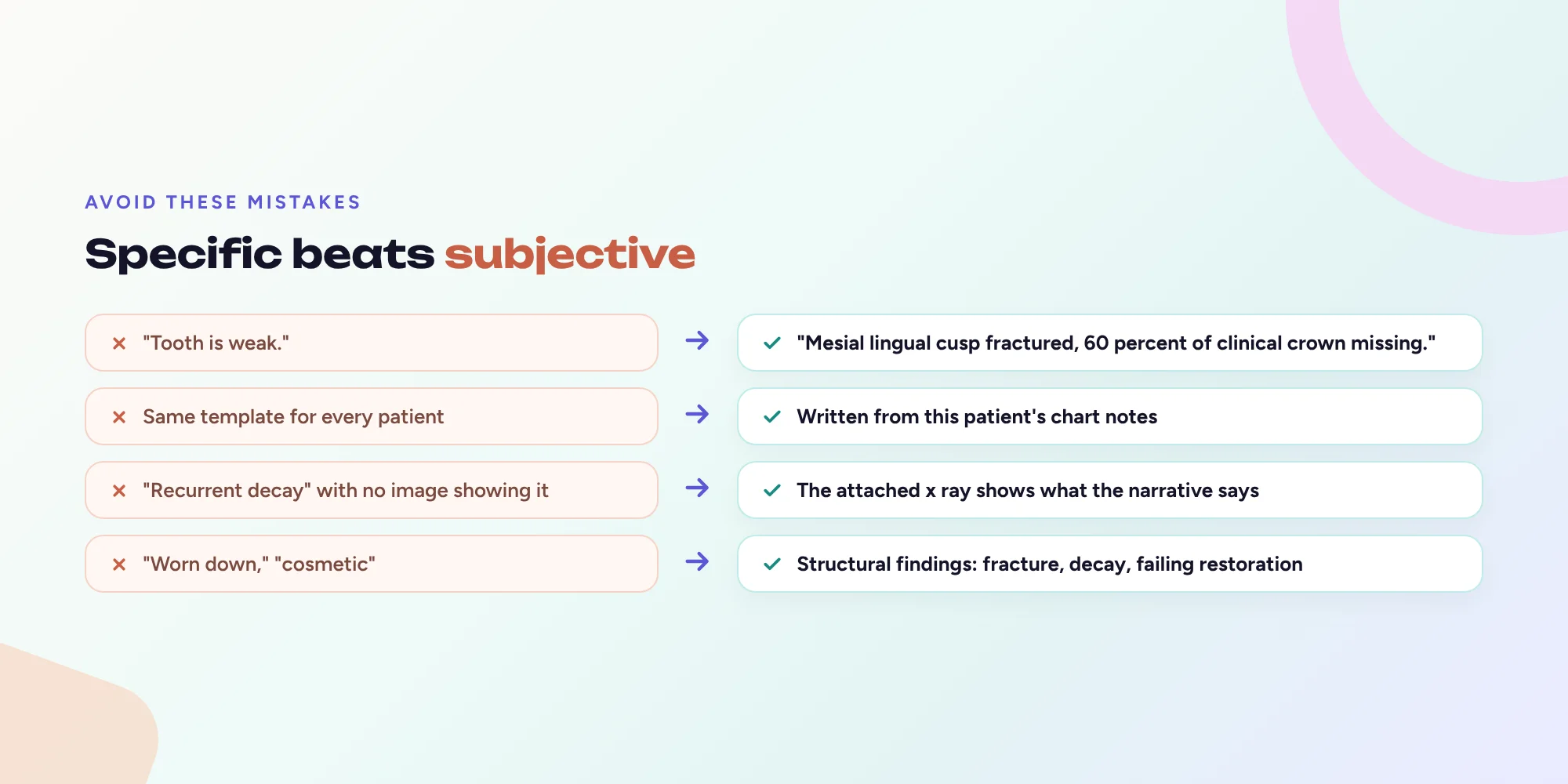
- Templated narratives. Some payers specifically flag notes that read the same across many patients. Write from the chart notes for this patient.
- Subjective words with no findings. "Tooth is weak" tells the reviewer nothing. "Mesial lingual cusp fractured, 60 percent of clinical crown missing" does.
- Narratives that don't match the attachments. If you say there's recurrent decay under the old filling, the x ray needs to show it.
- Cosmetic or wear reasons. Many payers don't cover crowns for wear, attrition or appearance alone.
- Old or wrong images. Payers often require a recent periapical showing the full crown and the root apex, or full mouth x rays within a set time frame.
Example narratives
These are illustrative examples to show the structure. Always write from the actual findings in your patient's chart, and check each payer's own guidelines.
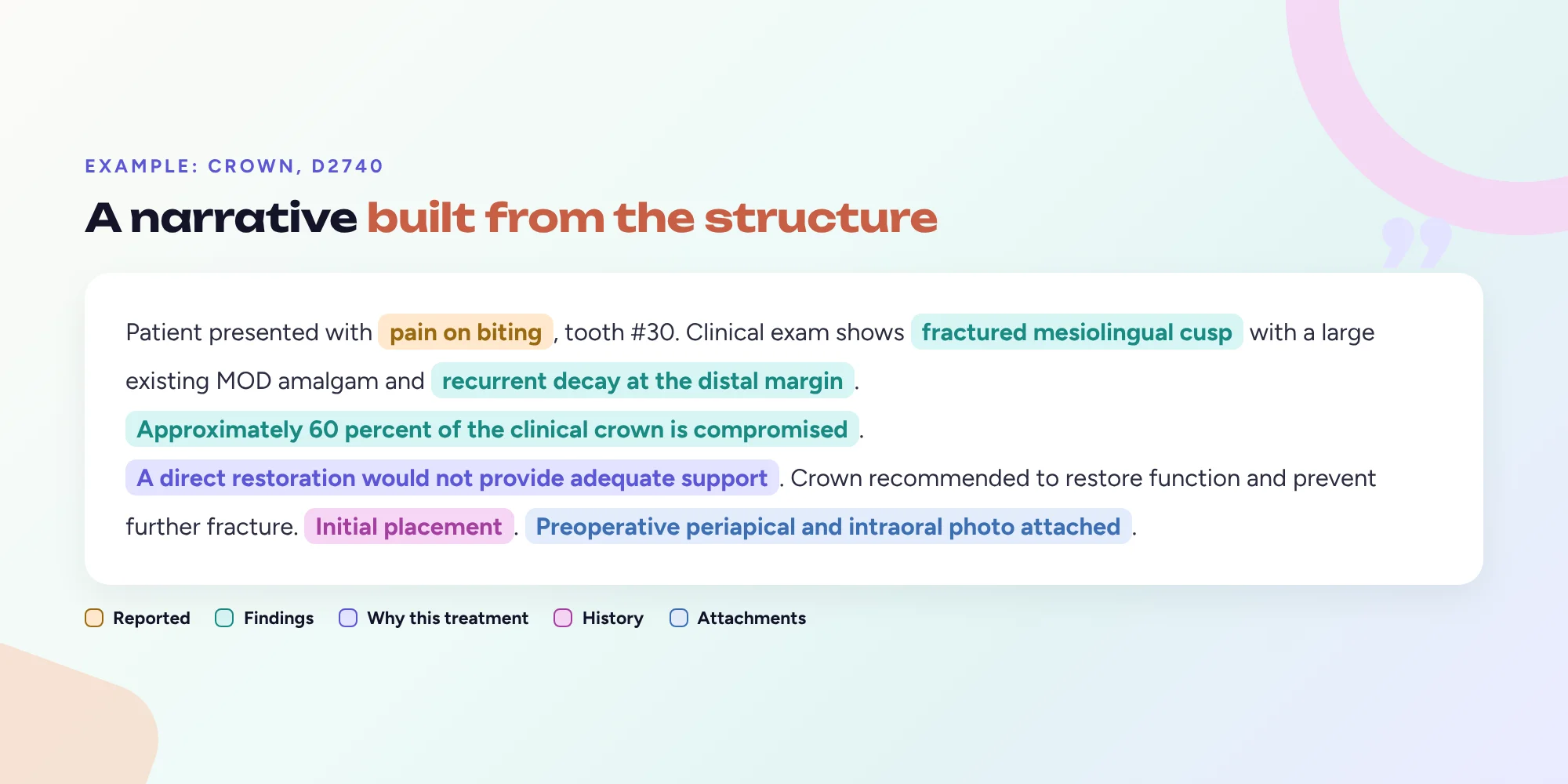
Crown (D2740) on tooth #30
Patient presented with pain on biting, tooth #30. Clinical exam shows fractured mesiolingual cusp with a large existing MOD amalgam and recurrent decay at the distal margin. Approximately 60 percent of the clinical crown is compromised. A direct restoration would not provide adequate support. Crown recommended to restore function and prevent further fracture. Initial placement. Preoperative periapical and intraoral photo attached.
Core buildup (D2950) on tooth #19
Following removal of failing restoration and decay on tooth #19, more than 50 percent of the coronal tooth structure was missing, with insufficient structure to retain a crown. Buildup placed to provide retention for the crown, not as a filler for undercuts. Preoperative periapical and postpreparation photo attached.
Scaling and root planing (D4341), upper right quadrant
Patient diagnosed with generalized Stage III Grade B periodontitis. Probing depths of 5 to 7 mm with bleeding on probing on teeth #2, 3, 4 and 5, with radiographic horizontal bone loss of 3 to 4 mm. Subgingival calculus present. Local anesthetic administered. Full mouth periodontal charting and full mouth x rays attached.
Surgical extraction (D7210) of tooth #14
Tooth #14 nonrestorable due to fracture extending below the bone level. Extraction required removal of bone and sectioning of the tooth due to divergent roots. Preoperative periapical attached.
Code specific tips
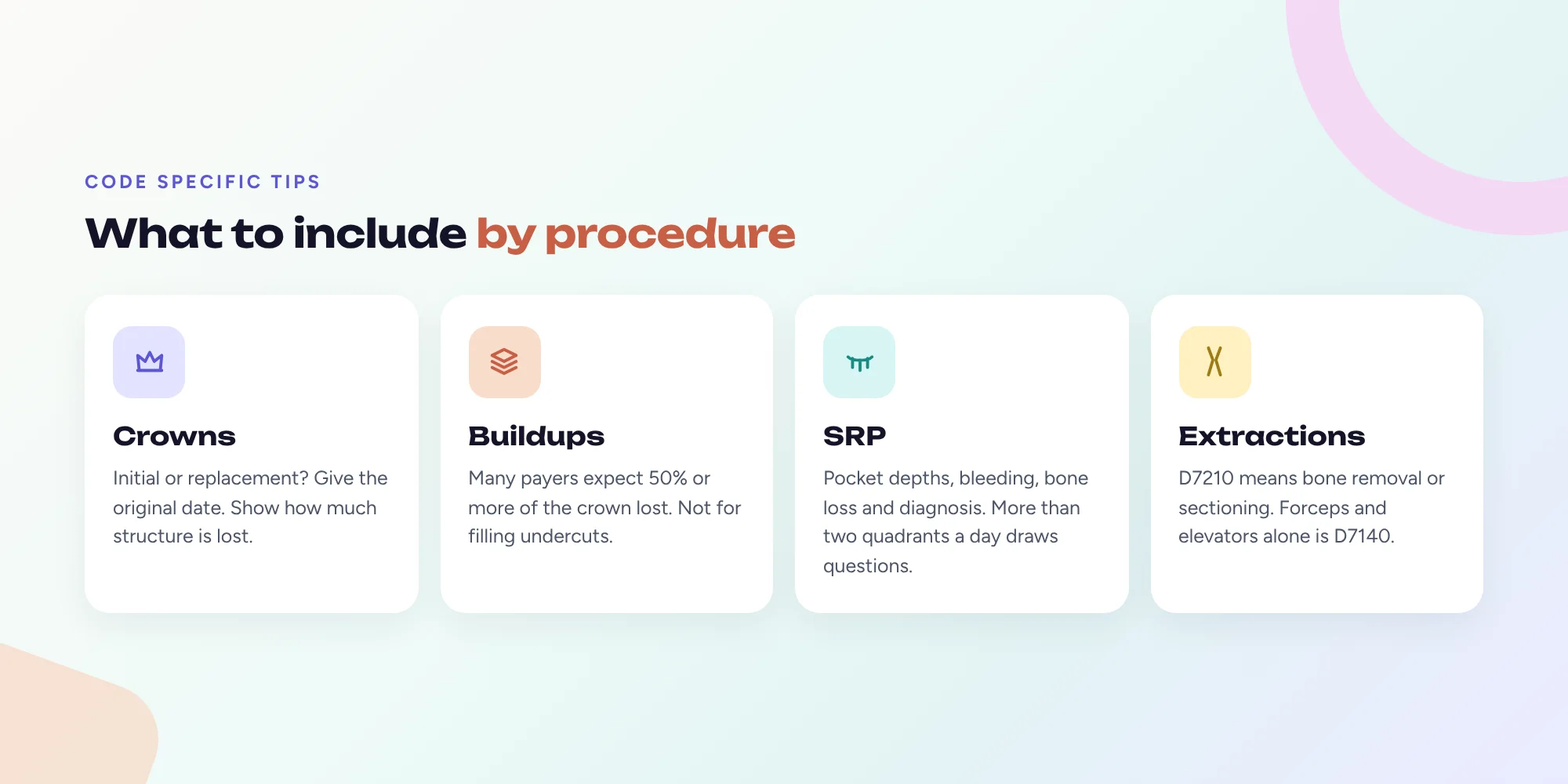
- Crowns: say whether it's an initial or replacement crown, and give the date of the original if replaced. Show the extent of tooth structure lost.
- Buildups: many payers expect loss of 50 percent or more of the natural crown, and won't pay for a buildup used only to fill undercuts.
- SRP: include pocket depths, bleeding, bone loss and the diagnosis. More than two quadrants on the same day often triggers a request for more information.
- Extractions: D7210 means bone removal or sectioning was needed. If the tooth came out with forceps and elevators alone, it's D7140.
Make it a system, not a scramble
The best narratives come from good clinical notes. If the provider documents findings clearly at the chair, the narrative almost writes itself. The worst narratives come from a front desk team member trying to reconstruct the visit days later.
Build a simple habit: providers note the key findings, the team turns them into a narrative using the structure above, and someone keeps a running list of what each major payer tends to ask for.
The bottom line
A narrative is a short, specific argument for medical necessity. Name the tooth, show the findings, explain why, and attach the proof.
Dental Maverick automates claim building in Open Dental, including drafting narratives from chart notes for the provider to review and sign. Get started at dentalmaverick.ai.